
Introduction
The Department of Electrical Engineering at Chenab University of Science and Technology was established in November 2009 and has steadily evolved into a center of academic excellence and innovation. Over the years, the department has successfully graduated multiple batches of engineers who are contributing to the industrial and technological growth of the country. Currently, several cohorts of undergraduate students are actively pursuing their degrees, reflecting the department’s continued growth and academic strength.
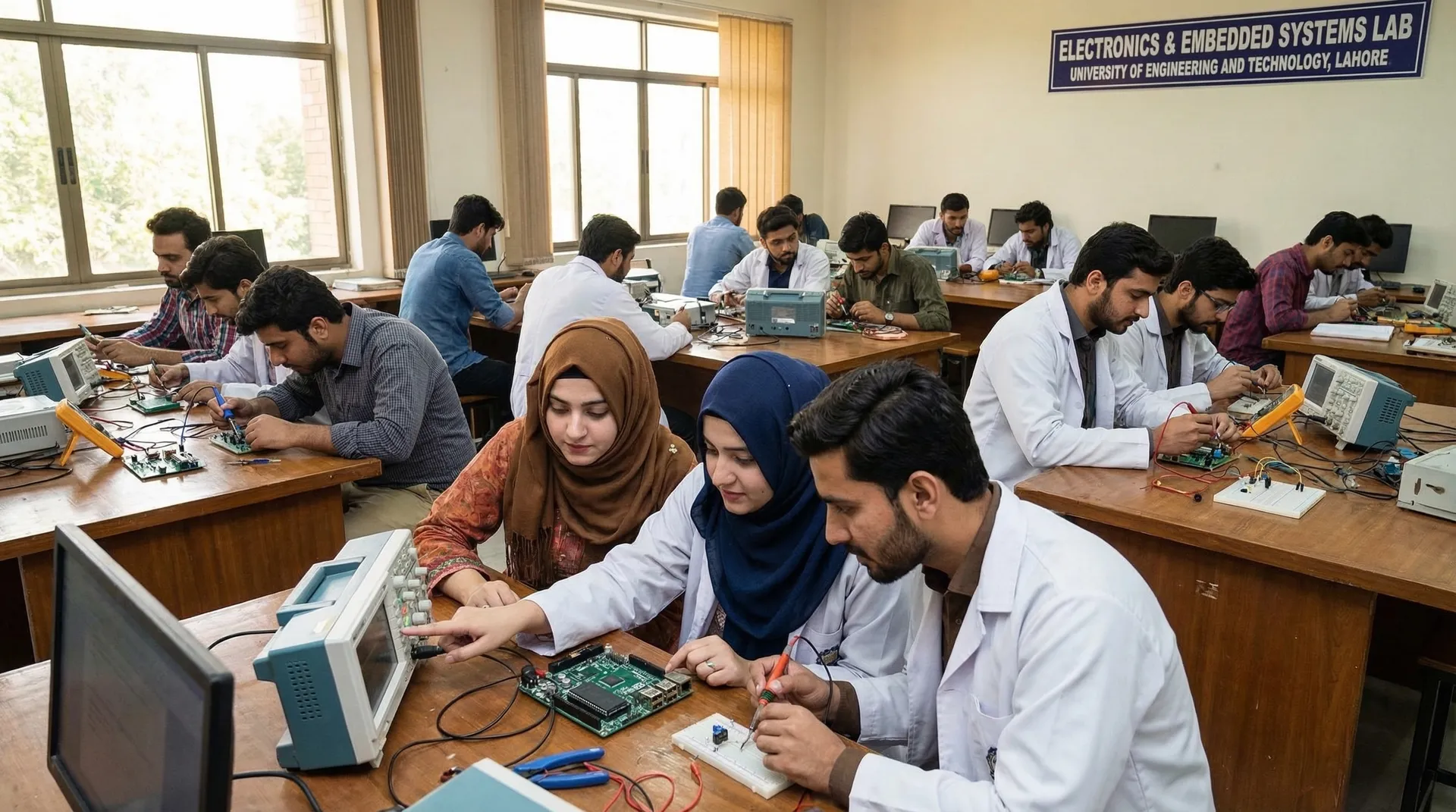
The department offers a comprehensive undergraduate program in Electrical Engineering with specialization in Power. The curriculum, designed in line with national academic standards and accredited by relevant regulatory bodies, covers a broad spectrum of core and advanced areas including Electrical Machines, Power Systems, Electronics, Control Systems, Computer Systems, and Communication Engineering. With well-equipped laboratories and modern learning facilities, students gain practical exposure alongside theoretical knowledge.
The department is committed to producing highly skilled graduates who are capable of addressing real-world engineering challenges. Our alumni are actively contributing to both public and private sectors, playing a vital role in meeting the growing demand for competent Electrical Engineers in Pakistan and beyond.
Mission
The mission of the Department of Electrical Engineering is to develop competent graduates equipped with modern technical knowledge and practical skills. The program is designed to expose students to national and global engineering challenges, enabling them to become effective problem-solvers.
We emphasize the development of professional ethics, leadership qualities, and decision-making abilities through a strong foundation in engineering principles, management, and economics. The department is also committed to fostering analytical thinking through complex engineering problem-solving and hands-on laboratory experience, preparing students to address real-life challenges in a dynamic technological environment.
Vision
To establish a center of excellence in Electrical Engineering that bridges academia and industry through innovation, research, and impactful learning.
ALIGNMENT OF PEOS WITH DEPARTMENT’S VISION AND MISSION
Department Vision & Mission | PEO-1 | PEO-2 | PEO-3 | PEO-4 | |
Vision | To build identity of excellence in Electrical engineering domain at intersection of academia and industry. | ✓ | ✓ | ✓ | ✓ |
Mission | a) To produce Electrical Engineering graduates equipped with state-of-the-art knowledge. b) Students are introduced to national needs and problems related to Electrical Engineering with a view to prepare them as future problems solvers. c) The students are taught ethics, management and economics to train them as professional Electrical Engineers and decision makers. d) To train the students to solve complex engineering problem and perform open-ended labs which shell prepare them to solve real life problems.
| ✓ | ✓ | ✓ | ✓ |
Program Learning Outcomes (PLOs)
The Program Learning Outcomes (PLOs) define the essential knowledge, skills, and professional attitudes that students are expected to acquire by the time of graduation. These outcomes align with internationally recognized graduate attributes and ensure that graduates are well-prepared to meet the demands of modern engineering practice, research, and industry.
Upon successful completion of the Electrical Engineering program, graduates will be able to:
Engineering Knowledge:
Apply principles of mathematics, natural sciences, engineering fundamentals, and specialized electrical engineering knowledge to solve complex engineering problems.Problem Analysis:
Identify, formulate, and analyze complex engineering problems using first principles of mathematics, science, and engineering, supported by research and critical thinking.Design & Development of Solutions:
Design innovative solutions for complex engineering challenges, ensuring consideration of public health, safety, societal, cultural, and environmental factors.Investigation:
Conduct thorough investigations of complex problems through research, experimentation, data analysis, and interpretation to reach valid and reliable conclusions.Modern Tool Usage:
Utilize appropriate modern engineering and IT tools, including simulation and modeling techniques, with an understanding of their limitations.The Engineer and Society:
Apply contextual knowledge to assess societal, legal, cultural, and safety aspects, and understand the professional responsibilities associated with engineering practice.Environment & Sustainability:
Evaluate the environmental and societal impact of engineering solutions and promote sustainable development practices.Ethics:
Demonstrate commitment to professional ethics, integrity, and responsible engineering practices in all professional activities.Individual & Team Work:
Work effectively both independently and as part of multidisciplinary teams, demonstrating leadership and collaboration skills.Communication:
Communicate effectively with the engineering community and society through clear reports, presentations, and professional interactions.Project Management:
Apply management principles and engineering knowledge to plan, execute, and lead projects in multidisciplinary environments.Lifelong Learning:
Recognize the importance of continuous learning and adapt to emerging technologies, ensuring professional growth and innovation.
Mapping of PEOs to PLOs/Graduate Attributes
| Program Learning Outcomes (PLOs) | PEO_1 | PEO_2 | PEO_3 | PEO_4 |
|---|---|---|---|---|
| Engineering Knowledge | ✓ | |||
| Problem Analysis | ✓ | |||
| Design/Development of solutions | ✓ | |||
| Investigation | ✓ | ✓ | ||
| Modern tool Usage | ✓ | |||
| The Engineer and Society | ✓ | |||
| Environmental and Sustainability | ✓ | |||
| Ethics | ✓ | ✓ | ||
| Individual and Team work | ✓ | |||
| Communication | ✓ | |||
| Project Management | ✓ | |||
| Lifelong Learning | ✓ |
Laboratories
| Department of Electrical Engineering Laboratories:
The Department of Electrical Engineering has well equipped state of the art laboratories have been setup , each of which has an area of 875 (35’ X 25’) sq. ft. with latest available techniques and instruments. There are 11 laboratories consisting of related instruments and equipment. The details are given | ||
| S. No. | Laboratory | Subject s Practical’s Covered |
| 1 | Electronics lab | • Linear Circuit Analysis
• Electronics Devices & Circuits |
| 2 | Advanced Electronics Lab | • Linear Control System
• Microprocessors Based System • FPGA based system • Robotics • DSP • Industrial Electronics (PLC) |
| 3 | Computer lab-I | • Introduction to Computing
• Computer Programming • Network Analysis • Signals and Systems • Engineering Drawing |
| 4 | Power Electronics and Communication Lab | • Industrial Electronics
• Power Electronics • Communication Systems |
| 5 | Digital Logic Design | • Digital Logic Design |
| 6 | Instrumentation & Measurement lab | • Instruments and Measurements |
| 7 | Thermodynamics-I Lab (Sharing) | • Applied Thermodynamics |
| 8 | Electrical Power Lab | • Power Distribution and Utilization
• Power System Protection • Power Transmission |
| 9 | Electrical Machine Lab | • Electrical Machines Fundamentals
• AC Machines |
| 10 | Drawing Hall | · Engineering Drawings |
| 11 | Project Lab | · Projects |