Introduction
The Department of Mechanical Engineering at Chenab University of Science and Technology is dedicated to developing highly skilled engineers equipped to meet the challenges of modern industry and technological advancement. Mechanical Engineering is one of the broadest and most versatile engineering disciplines, playing a vital role in sectors such as manufacturing, energy, automotive, aerospace, and industrial systems.
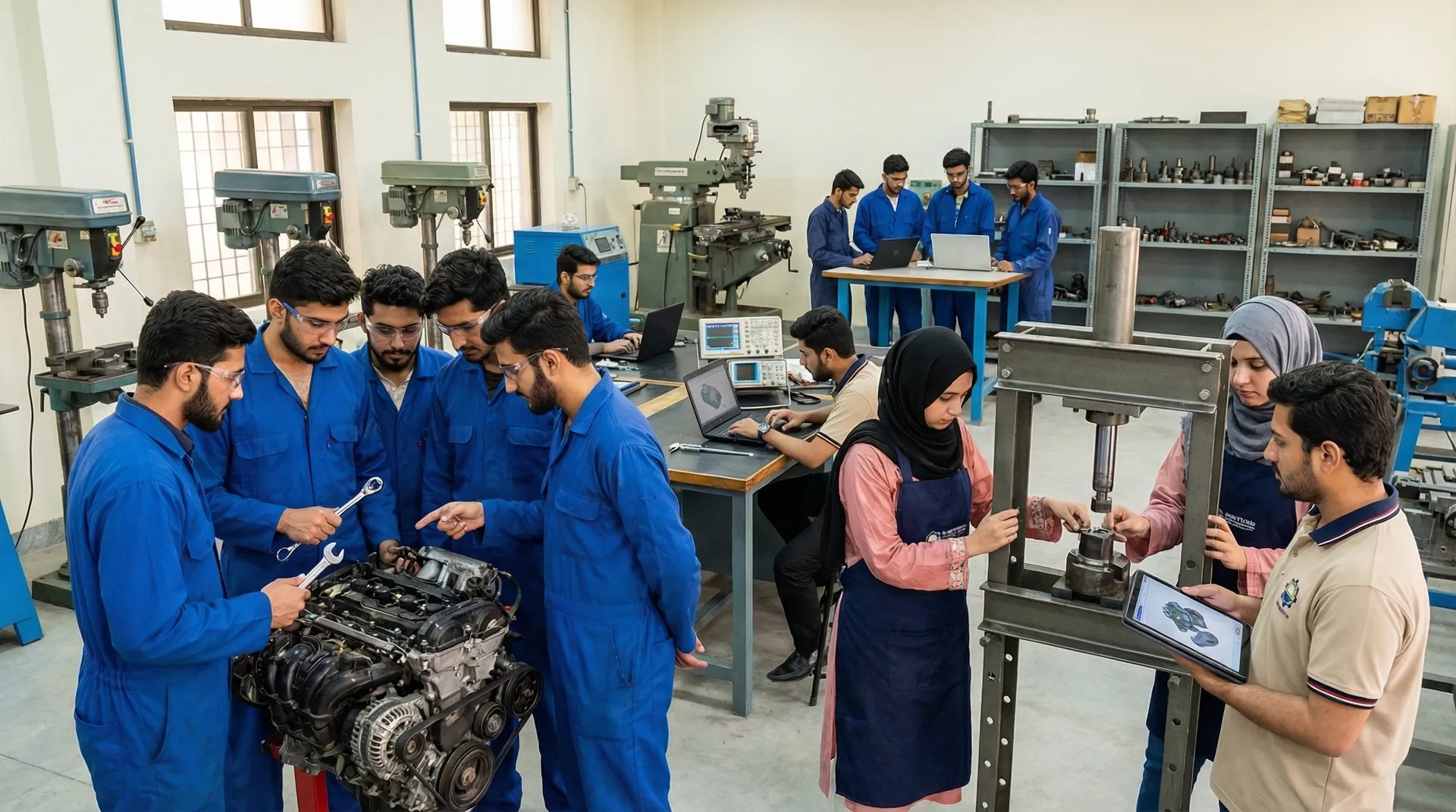
The program is designed to provide a strong foundation in core engineering principles including thermodynamics, fluid mechanics, mechanics of materials, manufacturing processes, and machine design. Students are exposed to both theoretical knowledge and practical applications through well-equipped laboratories, workshops, and project-based learning.
With a focus on innovation and problem-solving, the program integrates modern tools such as computer-aided design (CAD), simulation software, and advanced manufacturing techniques. Students are encouraged to engage in hands-on projects, research activities, and industrial internships to gain real-world experience.
The department aims to produce graduates who are not only technically competent but also capable of critical thinking, effective communication, and leadership. Our graduates are well-prepared to contribute to the industrial sector, pursue higher education, or engage in entrepreneurial ventures, supporting the technological and economic growth of the country.
Mission
The Mechanical Engineering program is committed to providing high-quality education that equips students with strong technical knowledge and practical skills. We aim to develop graduates who can analyze and solve complex engineering problems, adapt to emerging technologies, and contribute effectively to industry and society.
The program emphasizes ethical values, teamwork, and leadership while encouraging innovation and lifelong learning. Through modern laboratories, industry exposure, and project-based learning, students are prepared to meet national and global engineering challenges.
Vision
To become a leading center of excellence in Mechanical Engineering education and research, contributing to innovation, industry development, and sustainable solutions.
Message of HOD

Mechanical Engineering is widely regarded as the foundation of all engineering disciplines, playing a vital role in the advancement of industry, technology, and innovation. At Chenab University of Science and Technology, we are committed to delivering a comprehensive undergraduate program that equips students with the ability to design, manufacture, install, and operate complex mechanical systems and industrial processes.
Since the establishment of the department in 2010, we have successfully produced multiple batches of graduates who are now contributing in leading industries and academic institutions both in Pakistan and internationally. Our graduates have demonstrated a strong commitment to lifelong learning and have actively contributed to innovation, research, and technological development.
The department takes pride in its team of highly qualified and experienced faculty members with strong academic and industrial backgrounds. We continuously encourage professional development and higher education among both faculty and students. Many of our graduates have pursued postgraduate studies at prestigious engineering institutions, while others are engaged in advanced research programs at internationally recognized universities.
We place strong emphasis on research, innovation, and practical learning. Students are encouraged to undertake independent and impactful Final Year Projects (FYPs), addressing real-world challenges and contributing to national development. Notably, our students have achieved recognition through innovative projects, including patented work in the field of alternative energy.
In addition to academic excellence, the department actively promotes professional exposure through participation in national and international conferences, technical events, and professional societies. Such engagements provide valuable opportunities for students to interact with industry experts, broaden their perspectives, and enhance their professional growth.
At the Department of Mechanical Engineering, we are dedicated to developing competent, innovative, and ethically responsible engineers who are prepared to meet the challenges of a rapidly evolving global environment.
Engr. Prof. Dr. Muhammad Rizwan
Head of Department – Mechanical Engineering
Program Educational Objectives (PEOs)
The Department of Mechanical Engineering has been working to shift on Outcome Based Education (OBE) since Sep. 2018. Considerable efforts have been made towards shifting the existing system to OBE system for teaching and assessment criteria in accordance with PEC Manual of Accreditation 2014. For this purposes various steps have been taken. Some of which are as follows:
- Formulation of Vision and Mission statements of College and B.Sc. Mechanical Engineering Program.
- Formulation of Program Educational Objectives (PEOs) of B.Sc. Mechanical Engineering.
- Formulation of Program Learning Outcomes (PLOs) or Graduate Attributes (GAs) of B.Sc. Mechanical Engineering.
- Setting up of Quality Enhancement Cell (QEC) of College.
- Revision of Syllabus as per Continuous Quality Improvement (CQI) policy of the UET Lahore.
- Workshops on OBE system for awareness of teachers and students: Blooms Taxonomy of Cognition Domain and Psychomotor Domain, Graduate Attributes (GAs) or Program Learning Outcomes (PLOs), OBE criterion or rubrics of conducting and evaluating laboratory work.
- Distribution and collection of various survey forms for the indirect evaluation of program’s objectives, learning outcomes by the QEC.
- Preparation of OBE based course file of courses by teachers and lab engineers.
- Preparation of rubrics and methodology of conducting and evaluating Complex Engineering Problems (CEP).
- Preparation of Standard operating Procedure (SOP) of allocation of Final Year Projects (FYP) to students. Methodology of research, presentation of results, report writing, and evaluation rubrics of FYP.
Program Education Outcomes (PEOs)
At the completion of four years B.Sc. Mechanical Engineering Degree Program, graduates will be able to:
Program Education Objectives (POEs):
PEO 1: Apply the knowledge to solve analytical and practical engineering problems.
PEO 2: Work for continuous professional and socio-technical development of society.
PEO 3: Demonstrate Professional Ethics and exhibit strong communication and managerial
skills as a team leader as well as a team member.
Program Learning Outcomes (PLOs)
Program learning outcomes (PLOs) are the narrow statements that describe what students are expected to know and be able to do by the time of graduation. The program must demonstrate that by the time of graduation the students have attained the following graduate attributes (GAs):
PLO-1 Engineering Knowledge: Apply knowledge of mathematics, natural science, engineering fundamentals and Engineering specialization to the solution of complex engineering problems.
PLO-2 Problem Analysis: Identify, formulate, conduct research literature, and analyze complex Engineering problems reaching substantiated conclusions using first principles of mathematics, natural sciences and engineering sciences.
PLO-3 Design/Development of Solutions: An ability to design solutions for complex engineering problems and design systems, components or processes that meet specified needs with appropriate consideration for public health and safety, cultural, societal, and environmental considerations.
PLO-4 Investigation: Conduct investigation of complex Engineering problems using research-based knowledge and research methods, including design of experiments, analysis and interpretation of data, and synthesis of information to provide valid conclusions.
PLO-5 Tool Usage: Create, select and apply appropriate techniques, resources, and modern engineering and IT tools, including prediction and modeling, to complex Engineering problems, with an understanding of the limitations.
PLO-6 The Engineer and the World: Analyze and evaluate sustainable development impacts to society, the economy, sustainability, health and safety, legal frameworks, and the environment while solving complex engineering problems.
PLO-7 Ethics: Apply ethical principles and commit to professional ethics and norms of engineering practice and adhere to relevant national and international laws. Demonstrate an understanding of the need for diversity and inclusion.
PLO-8 Individual and Collaborative Teamwork: Function effectively as an individual, and as a member or leader in diverse and inclusive teams and in multi-disciplinary, face-to-face, remote and distributed settings.
PLO-9 Communication: Communicate effectively and inclusively on complex engineering activities with the engineering community and with society at large, such as being able to comprehend and write effective reports and design documentation, and make effective presentations, considering cultural, language, and learning differences.
PLO-10 Project Management and Finance: Demonstrate knowledge and understanding of engineering management principles and economic decision making and apply these to one’s own work, as a member and leader in a team, to manage projects in multidisciplinary environments.
PLO-11 Lifelong Learning: Recognize the need for and have the preparation and ability for independent and life-long learning, adaptability to new and emerging technologies and critical thinking in the broadest context of technological change.
Program Learning Outcomes (PLOs)
Program learning outcomes (PLOs) are the narrow statements that describe what students are expected to know and be able to do by the time of graduation. The program must demonstrate that by the time of graduation the students have attained the following graduate attributes (GAs):
PLO-1 Engineering Knowledge: Apply knowledge of mathematics, natural science, engineering fundamentals and Engineering specialization to the solution of complex engineering problems.
PLO-2 Problem Analysis: Identify, formulate, conduct research literature, and analyze complex Engineering problems reaching substantiated conclusions using first principles of mathematics, natural sciences and engineering sciences.
PLO-3 Design/Development of Solutions: An ability to design solutions for complex engineering problems and design systems, components or processes that meet specified needs with appropriate consideration for public health and safety, cultural, societal, and environmental considerations.
PLO-4 Investigation: Conduct investigation of complex Engineering problems using research-based knowledge and research methods, including design of experiments, analysis and interpretation of data, and synthesis of information to provide valid conclusions.
PLO-5 Tool Usage: Create, select and apply appropriate techniques, resources, and modern engineering and IT tools, including prediction and modeling, to complex Engineering problems, with an understanding of the limitations.
PLO-6 The Engineer and the World: Analyze and evaluate sustainable development impacts to society, the economy, sustainability, health and safety, legal frameworks, and the environment while solving complex engineering problems.
PLO-7 Ethics: Apply ethical principles and commit to professional ethics and norms of engineering practice and adhere to relevant national and international laws. Demonstrate an understanding of the need for diversity and inclusion.
PLO-8 Individual and Collaborative Teamwork: Function effectively as an individual, and as a member or leader in diverse and inclusive teams and in multi-disciplinary, face-to-face, remote and distributed settings.
PLO-9 Communication: Communicate effectively and inclusively on complex engineering activities with the engineering community and with society at large, such as being able to comprehend and write effective reports and design documentation, and make effective presentations, considering cultural, language, and learning differences.
PLO-10 Project Management and Finance: Demonstrate knowledge and understanding of engineering management principles and economic decision making and apply these to one’s own work, as a member and leader in a team, to manage projects in multidisciplinary environments.
PLO-11 Lifelong Learning: Recognize the need for and have the preparation and ability for independent and life-long learning, adaptability to new and emerging technologies and critical thinking in the broadest context of technological change.
Mapping, Vision, Mission and PEOs
PLO Mapping with PEOs
PLO/GA | Program Learning Outcomes (PLOs) | PEOs | ||
Sr No. | PEO-1 | PEO-2 | PEO-3 | |
01 | Engineering Knowledge | ✓ | ||
02 | Problem Analysis | ✓ | ||
03 | Design Development of Solution | ✓ | ||
04 | Investigation | ✓ | ||
05 | Tool Usage | ✓ | ||
06 | The Engineer and the World | ✓ | ||
07 | Ethics | ✓ | ||
08 | Individual and Collaborative Teamwork | ✓ | ||
09 | Communication | ✓ | ||
10 | Project Management and Finance | ✓ | ||
11 | Lifelong Learning | ✓ | ||
Department Mission Mapping with PEOs
Department Mission | PEO-1 | PEO-2 | PEO-3 | |
Mission | To produce engineers with broad & in-depth knowledge, creativity, who are capable of solving mechanical engineering problems for societal benefits, following professional ethics. | ✓ | ✓ | ✓ |